

John Maringa Githaka, PhD
Director of Translational Laboratory Shared Service at the WVU Cancer Institute
John Maringa Githaka, PhD, keeps a photo of himself with several of his childhood classmates on the corner of his desk in his office at the WVU Cancer Institute. When describing it, he recalls his earliest years of education taking place in schoolhouses without windows, with many of his classmates attending without shoes.
Decades later, Githaka’s career has taken him to Morgantown, WV, thousands of miles away from his small hometown in Mutithi, Kenya. Joining the WVU Cancer Institute last September, Githaka brings with him a unique skill set in developing patient-derived organoid (PDO) models, a lab-grown version of an organ. Along with his research, Githaka serves as service assistant professor and director of the Translational Laboratory Shared Service Core at the WVU Cancer Institute.
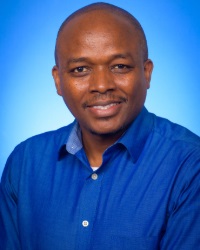
John Maringa Githaka, PhD
His decision to accept the position was helped by a push from the National Institutes of Health (NIH) to implement those models to better understand how aggressive cancer affects patients.
After 15 years at the University of Alberta, a place where he defended his thesis before becoming a postdoctoral fellow and research associate, Githaka felt the WVU Cancer Institute was a perfect fit for the next stage of his career.
“I was looking for someplace where I could grow,” Githaka said. “With research, one thing leads to another, and I’m doing basic research…before I know it, we’re in the translation angle of it. At some point you’ve gained enough skills, now it’s the time of be independent and find those opportunities where you can articulate those skills, expand them and even transfer them to other areas.”
His team at the WVU Cancer Institute has focused on developing PDO models of lung cancer, particularly non-small cell lung cancer as it remains prevalent to West Virginians. Githaka has worked to develop a PDO platform that mimics cancer in a patient that can’t be preserved in 2D models. By observing organoid drug responses, the research allows doctors to create more personalized treatment plans for patients based on their specific case. This kickstarts a process that can lead to clinical trials, which if proven and reproduced by other research methods, could translate into life-changing treatments for patients.
“We are culturing them in a three-dimensional culture environment, which is essentially what we are as humans,” Githaka said. “Our cells experience a three-dimensional sort of space, versus, with the earlier models, it was more flat plates.”
Githaka and his team have also introduced cancer-associated fibroblasts (connective tissue cells in a human body) and extracellular matrix (a material of protein and fiber that surrounds cells) to its models to determine if their presences make it more difficult for drugs to attack the cancer cells.
As head of a translational core, his job is to bridge the gap between discoveries in the laboratory to clinical applications that help improve treatments, while providing expertise and consultation to fellow researchers.
“Without this translational core, I could see us still doing the same old things, still progressing slowly,” Githaka said. “But with the new models, we are able to accelerate that and get us closer to translatable discoveries.”
Humble Beginnings
Githaka grew up an hour and a half outside Nairobi, Kenya, in a small village in the rice farming region of the country that lies in the shadow of Mt. Kenya, Africa’s second-highest mountain. While outside of the classroom, he spent his younger days hunting and fishing in the region.
It was a simple life.
“Life from an outsider, it looks rough but those are some of the best memories, I have to be honest,” Githaka said. “You have all of these experiences that enrich you, but you have no idea of the outside world.”
Growing up in a region with strong reliance in agriculture, Githaka was quickly equipped with a solid work ethic picked up from those around him. During holiday breaks from his studies, Githaka and his classmates worked together to till the soil in the cornfields at the school.
“You don’t have that much in terms of resources, but it’s just so rich in experience that it supersedes resources in a way that I can’t explain,” Githaka said.
Githaka and his schoolmates all had jobs to complete on a rotating basis, including cleaning the bathrooms and landscaping around the property. He says the responsibility he was given from a young age shaped who he is today.
“I always feel like it’s one of those things where if I hadn’t had those experiences, I would probably be in a very different place that I wouldn’t even like,” Githaka said. “There are a lot of values that are instilled in you, be it family values, work ethic.”
After finishing grade school, Githaka spent two years working as a farmer — tracking and saving every penny earned and putting it towards his future — before enrolling in higher education.
“Those things just make you a better person in life because you don’t take things for granted, and at the same time you have experienced both sides of the world,” Githaka said. “You kind of appreciate where you’re at in life and it kind of grounds you.”
Githaka will be the first to admit he wasn’t too familiar with oncology during his younger years. What he did know, however, like many Kenyans pursuing higher education, was that he wanted to enroll in medical school.
The acceptance letter never came.
Seeking an alternative career path in a related field, he elected to study biochemistry at Moi University, a Kenyan public school. It was there that he became comfortable conducting laboratory research before graduating in 2009.
At age 22, he handwrote a letter to Nairobi’s International Center of Insect Physiology and Ecology, seeking an opportunity to further his research skills. It was a modern facility that had all the technology available to him that he has now since become used to. His letter got into the right hands, and he was awarded an internship in the summer of 2008.
“I was just looking for an attachment,” Githaka said. “I wanted to be in a research facility. Luckily, they gave me an opportunity.”
His experience in the capital city was enough to give him admission to the University of Alberta, a school made available to him due to its application fee being waived for Kenyans at the time. He continued to develop a skillset in research by serving as a microscopy workshop instructor, graduate teaching assistant and graduate research assistant before earning his Doctor of Philosophy (PhD) in Biochemistry in 2015.
Despite being over 7,000 miles away from his hometown in Eastern Africa, the lessons Githaka picked up during his childhood drive his work every day, with the photo of his youngest years serving as a reminder on his desk in Morgantown.