

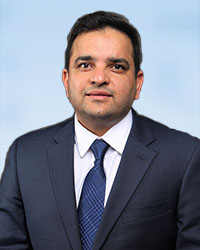
Shailendra Singh, MD, Director of Advanced Therapeutic Endoscopy
“I’ve always believed that patients here deserve the same cutting-edge options available at major medical centers across the country.”
At the WVU Cancer Institute, Shailendra Singh, MD, is dedicated to ensuring that patients in West Virginia and the surrounding region have access to the most advanced diagnostic and therapeutic endoscopic care — close to home.
“I’ve always believed that patients here deserve the same cutting-edge options available at major medical centers across the country,” Dr. Singh said. “Over the last several years, we’ve worked hard to bring those technologies to our community.”
Dr. Singh is a gastroenterologist, director of advanced therapeutic endoscopy, and a professor at WVU Medicine. He is part of the WVU Medicine Advanced Center for Endoscopy – the only nationally recognized academic and research-focused advanced endoscopy center in West Virginia. The center specializes in minimally invasive techniques to diagnose and treat complex gastrointestinal and pancreatic conditions, including pancreatic cancer.
What Is Advanced Endoscopy?
Advanced endoscopy uses specialized scopes and imaging tools to diagnose and treat disease from inside the body, without large incisions or traditional surgery. These procedures, often done through the mouth, use a flexible tube equipped with a camera and, in some cases, ultrasound technology.
Dr. Singh performs more than 1,000 complex endoscopic procedures each year. One of the most important tools in his practice is endoscopic ultrasound, also known as EUS.
“An endoscopic ultrasound lets us see not only the digestive tract, but also nearby organs like the pancreas,” he explained. “It allows us to diagnose cancer, take biopsies, drain fluid collections, place stents, and treat tumors – all in a minimally invasive way.”
For many patients, this means shorter recovery times, fewer complications, and the ability to go home the same day.
A Focus on Pancreatic Cancer
While advanced endoscopy is used for many conditions, pancreatic care makes up the majority of Dr. Singh’s clinical work. Large part of his practice focuses on pancreatic cancer and pancreatitis. “Pancreatic cancer is one of the most challenging cancers we treat,” Dr. Singh said. “It’s aggressive, often diagnosed late, and survival rates remain low. That’s why early diagnosis is important and there is a need for innovative treatment options to improve survival.”
At the Cancer Institute, Dr. Singh works closely with surgeons, oncologists, radiologists, and other specialists as part of a multidisciplinary cancer team. Together, the team reviews complex cases and creates individualized care plans for each patient.
“Our approach is very team-based,” he said. “Every patient is different, and we take the time to decide what’s best for that person.”
Innovation in Care
Since coming to WVU Medicine in 2020, Dr. Singh has helped establish new technologies previously unavailable in the state – and, in some cases, not available anywhere else in the country.
In 2025, WVU Medicine specialists performed the first endoscopy-guided microwave ablation of pancreatic lesions in the United States. This treatment uses minimally invasive technology to target tumors that cannot be treated with surgery alone.
“We are actively involved in clinical trials and investigator-initiated research focused on cutting-edge endoscopic therapies,” Dr. Singh said. “Our goal is not only to improve current options, but to help develop the next generation of treatments for patients with cancer.”
Keeping Patients Close to Home
One of Dr. Singh’s strongest motivations is improving access to specialized, high-quality care in West Virginia.
“Not long ago, many patients had to travel to places like Cleveland or Baltimore for advanced endoscopic care,” he said. “Now, we’re able to offer comprehensive, world-class care right here.”
That includes diagnosis, treatment, follow-up, and coordination with other cancer specialists – all under one roof.
Rooted in West Virginia
Dr. Singh earned his medical degree in his home country of India before moving to Pittsburgh, where he completed his internal medicine residency and fellowships in gastroenterology and advanced endoscopy. He later moved to West Virginia, which he now proudly calls home. His wife, Monica Chowdhry, M.D., is a gastroenterologist at WVU Medicine, and together they are raising their twin sons in Morgantown.
“What attracted me to WVU Medicine is the people,” Dr. Singh said. “Everyone is warm, humble, and deeply compassionate, yet also hardworking, highly skilled, and committed to providing the best possible care. “We have accomplished a great deal in the last five years at the Advanced Endoscopy Center. None of that would be possible without the entire team working together the way we do.”
When he’s not working, Dr. Singh enjoys spending time with his family, traveling when possible, and exploring new restaurants – especially in Morgantown, Pittsburgh, and nearby cities.
Looking Ahead
As advanced endoscopy continues to evolve, Dr. Singh remains focused on thoughtful, patient-centered innovation.
“I’m always looking ahead — asking what’s next and how we can responsibly push boundaries to provide better outcomes for our patients.”